Creative Commons Licenses for Research Explained: CC BY to CC BY-NC-ND
Introduction: Why Creative Commons Licenses Matter in 2026 (Why Now)
In 2026, as more and more academic research appears online,
often in open-access journals or stored in institutional repositories or on
internet education websites, the researcher who publishes work in 2026 must
consider the question of how readers and other scientists may use this
research:
When we want to publish our works and make sure people use
them the right way, Creative Commons (CC) licenses are a very useful tool in
that way. They allow us, scholars, who use academic publishing, open science or
digital research communication, to share everything we want to share, while
putting some restrictions or conditions not to misuse or modify them. This
article describes in a simple, practical and constructive way the Creative
Commons licenses,
What are Creative Commons (CC) Licenses?
The are simple, standard, pre-written copyright licenses,
which a creator can attach to their content. They allow that creator to tell
the rest of the world just how they may re-use or distribute that content.
They help researchers:
- Share
research openly
- Protect
intellectual property
- Clarify
usage permissions
CC licenses are widely used in:
- Open-access
publishing
- Educational
resources
- Research
repositories
- Online
academic content
Why CC Licenses are Important in Research
Creative Commons licenses help:
Increase research accessibility
Support open science initiatives
Encourage legal sharing and reuse
Protect author rights
Clarify permissions for readers and researchers
They ease copyright compliance in academic publishing.
How Creative Commons Licensing Works
The author retains the copyright ownership but is providing
the rights to others to be able to use it.
Users can understand:
- What
they may do with the work
- What
restrictions apply
This creates transparency in research sharing.
Main Elements of Creative Commons Licenses
When you create your works in Creative Commons you mix
between conditions
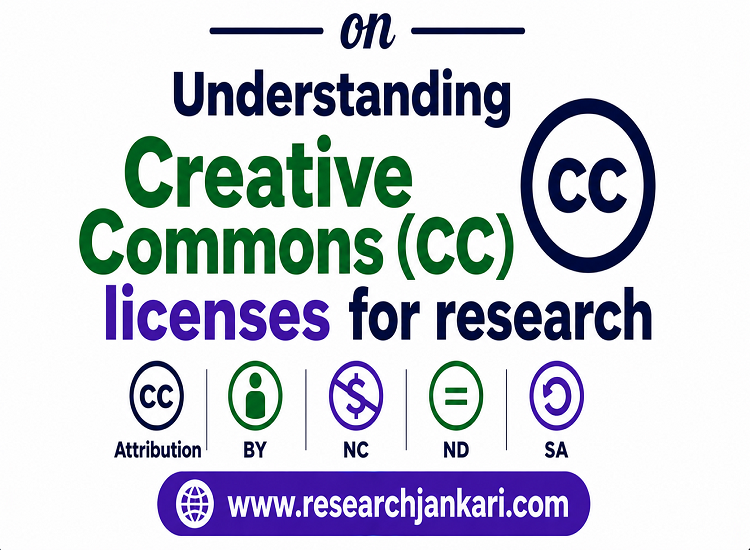
BY — Attribution
Everyone else has to acknowledge the proper source.
SA — ShareAlike
All modified must be licensed with the same licence.
NC — NonCommercial
Work cannot be for any commercial use.
ND — NoDerivatives
The material cannot be altered or changed by others.
Types of Creative Commons Licenses
1. CC BY (Attribution)
What It Allows
- Sharing
- Distribution
- Modification
- Commercial
use
as long as proper credit is given.
Most Open License
Widely used in open-access journals.
2. CC BY-SA (Attribution-ShareAlike)
Others may:
- Share
- Modify
- Adapt
but all subsequent versions must be governed by the same
terms.
3. CC BY-NC (Attribution-NonCommercial)
Permits use of resource only on commercial basis for
nonprofit.
4. CC BY-ND (Attribution-NoDerivatives)
Work can be attributed or shared amongst individuals but
individuals cannot do modifications to the software and content.
5. CC BY-NC-SA (Attribution-NonCommercial-ShareAlike)
Author can allow noncommercial reuse under the same license.
6. CC BY-NC-ND (Attribution-NonCommercial-NoDerivatives)
Most restrictive CC license.
Others can:
- Download
- Share
but cannot modify or use commercially.
Comparison of Creative Commons Licenses
|
License |
Commercial Use |
Modification Allowed |
|
CC BY |
Yes |
Yes |
|
CC BY-SA |
Yes |
Yes |
|
CC BY-NC |
No |
Yes |
|
CC BY-ND |
Yes |
No |
|
CC BY-NC-SA |
No |
Yes |
|
CC BY-NC-ND |
No |
No |
Which CC License is Common in Research?
Many open-access journals use:
- CC
BY
Because it supports widest dissemination and search ability
of the research.
CC Licenses and Open Access Publishing
In an open access publishing environment Creative Commons
licenses may be attached to journals like:
- Increase
accessibility
- Clarify
reuse permissions
- Promote
knowledge sharing
Always consult journal licensing rules.
Practical Example
Open access published in CC BY by a researcher.
Other researchers may:
- Share
the paper
- Cite
it
- Translate
it
- Use
figures with attribution
In turn expanding the fields of study and collaborative
work.
Benefits of Creative Commons Licensing
Improves research visibility
Encourages legal sharing
Supports global knowledge access
Clarifies copyright permissions
Enhances academic collaboration
Limitations and Considerations
Once applied, some CC licenses cannot easily be reversed
Researchers must choose the license carefully
Commercial reuse restrictions may limit dissemination in some cases
How to Choose the Right CC License
Researchers should consider:
Do they allow modifications?
Do they allow commercial use?
Do they support open science goals?
What are journal or funder requirements?
Common Misunderstandings About CC Licenses
“Creative Commons means no copyright.”
Incorrect — authors still keep copyright ownership.
“All CC licenses allow free commercial use.”
Not true — some licenses restrict commercial usage.
“CC licenses remove the need for citation.”
Incorrect — attribution is usually required.
Creative Commons and Research Ethics
Using CC licenses properly supports:
- Transparency
- Fair
attribution
- Ethical
academic sharing
Always be sure to follow the terms of the license as a
researcher.
Common Mistakes to Avoid
Using copyrighted material without checking licenses
Choosing licenses without understanding restrictions
Ignoring attribution requirements
Confusing open access with unrestricted use
Future of CC Licensing in Academia
The incorporation of Creative Commons licensing in:
- Open-access
journals
- Institutional
repositories
- Educational
platforms
- Government-funded
research policies
Open science communities are gaining momentum across the
world.
Tips for Researchers
Read journal copyright policies carefully
Use attribution properly when reusing content
Understand differences between licenses
Consider visibility goals before selecting licenses
Use CC licenses to support ethical knowledge sharing
Conclusion
Open access at the time became very fashionable as well,
especially through the use of licenses from Creative Commons. Creative Commons
licensing is one of the key ways in 2026 that researchers can submit their own
work for use by other researchers.
Creative Commons licenses enable academics to actively take
part in the open science movement, increase the visibility of the work, and
maintain their IP rights in ethical ways. For current researchers, knowledge of
Creative Commons licensing has become a significant aspect of scientific
publishing skills.
FAQs
What are Creative Commons licenses?
They are copyright licenses that define how others may use a creator’s work.
Does a CC license remove copyright ownership?
No, the creator still owns the copyright.
Which CC license is most open?
CC BY is considered the most open and flexible license.
Can CC-licensed research be used commercially?
Only if the license allows commercial use.
Why are CC licenses important in research?
They improve legal sharing, accessibility, and transparency in academic
publishing.
Advertisements